


What is JOLTS
The Job Openings and Labor Turnover Survey (JOLTS) is a monthly BLS publication tracking three labor market flows: job openings, hires, and separations. Separations break further into quits, layoffs and discharges, and other exits. The BLS pulls estimates from roughly 21,000 nonfarm establishments, asking about activity in the final month of the reference period, then seasonally adjusts and scales to national totals.
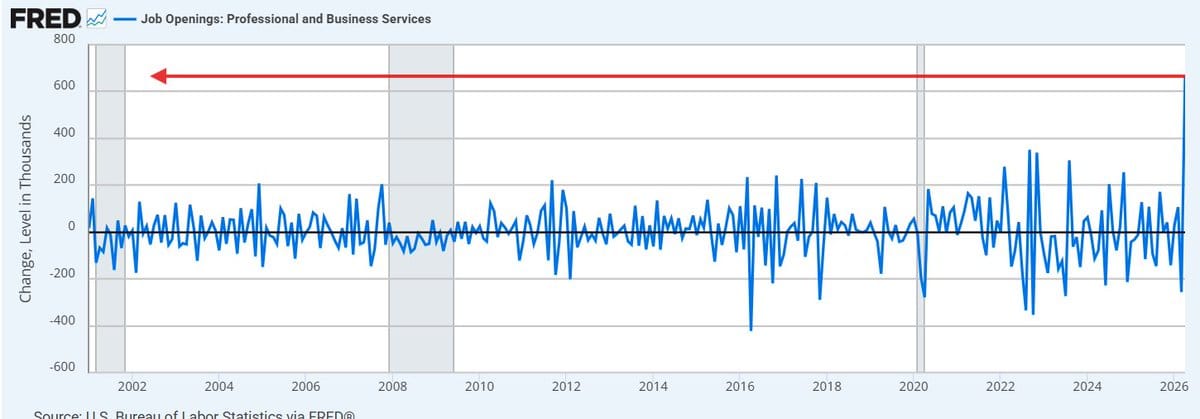
The April 2026 release showed 7.618m open positions, 5.12m hires, and 5.0m total separations.
Why it matters
Launched in 2002, JOLTS spent its first decade as specialist reading. It moved to center stage after the Global Financial Crisis, when then-Fed Chair Janet Yellen began publicizing the vacancies-to-unemployed (V/U) ratio as a sharper tightness measure than the unemployment rate alone. The logic: more open jobs than unemployed workers means a tight market, regardless of what the headline rate says.
That framing became load-bearing during the post-pandemic inflation episode. Job openings peaked near 12m in March 2022 and the V/U ratio hit roughly 2.0, two vacancies for every unemployed American. It was the kindling behind the sharpest inflation surge since the 1980s and the Fed's 525-basis-point hiking cycle. Fed communication became inseparable from the ratio after that, and markets followed.

How to interpret it
Of all the numbers the release produces, the V/U ratio gets the most attention. Above 1.0 signals employer competition for a limited worker pool, which tends to push wages up; below 1.0 suggests slack, with more job seekers than open positions. In March 2025, the ratio dipped below parity for the first time since the pandemic, a milestone many read as the labor market finally returning to balance. April 2026 reversed that in one month: openings jumped by roughly 731,000, pushing the ratio back above 1.0 against an unemployment count of approximately 7.1m people.
The April release came with an internal contradiction: openings surged while hires fell by 419,000. More postings and fewer actual placements is the definition of what analysts call a "low-hire, low-fire" market. Firms are signaling demand without committing to it. The quits rate, historically a proxy for worker confidence, sat near 1.85% in April, well below both the November 2021 peak of 3.0% and the pre-pandemic norm of roughly 2.3%. Workers are not leaving for better opportunities, which runs counter to what a hot vacancy number usually implies.
There is also a structural sampling problem. JOLTS draws on 21,000 establishments out of roughly 10m nonfarm employers, and a single month's reading can swing by hundreds of thousands without reflecting a genuine structural shift. April beat consensus by 738,000 openings. No policy framework should pivot on a number that volatile, yet markets priced out near-term rate cuts within hours of the release.
Key takeaways
The survey offers something payrolls data cannot: a direct read on unfilled labor demand and worker mobility. The V/U ratio has become the Fed's preferred real-time tightness gauge, which is why JOLTS moves markets out of proportion to its sample size or revision history. April 2026's data gave officials a fresh reason to stay on hold while also showing the underlying labor market is neither freely hiring nor shedding workers. That combination is harder to read than a clean tightening signal, and harder still to communicate from a podium.
Discussion