


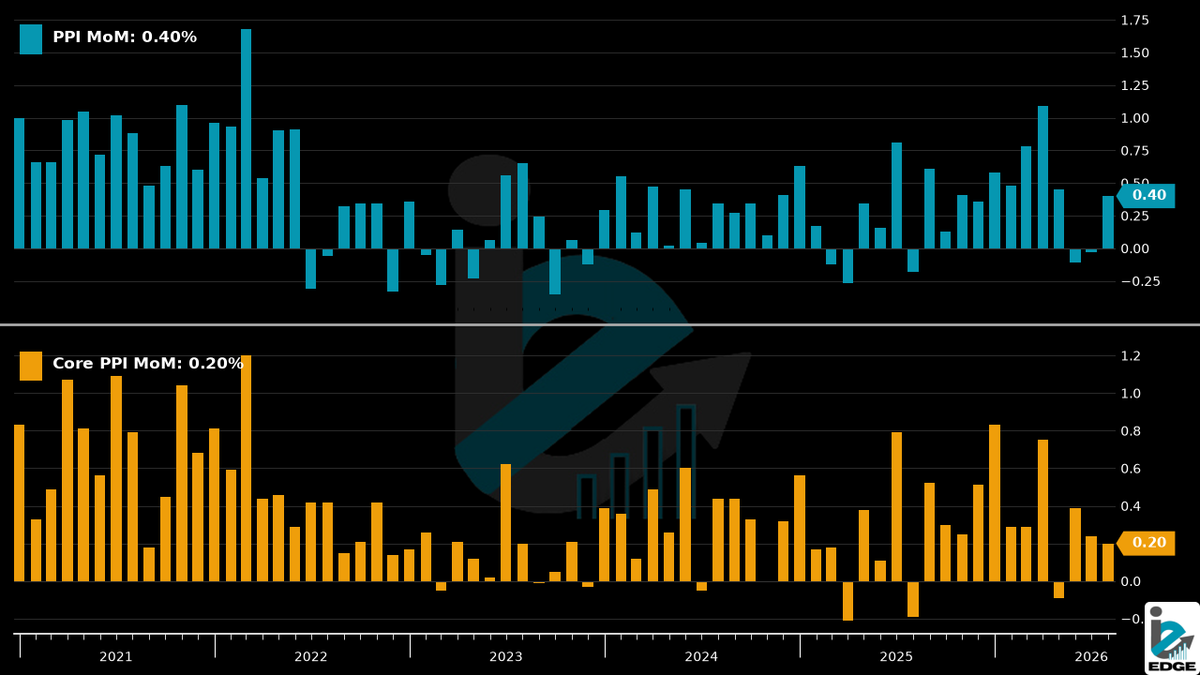
Most coverage of the Producer Price Index (PPI) stops at the headline. That's a mistake: the headline is the last stop, not the first. The real forecasting value sits one layer upstream, in the stages of production that feed into it, and this month's report is a clean case study in why.
What is the Producer Price Index
The PPI, published monthly by the Bureau of Labor Statistics (BLS), measures the average change in prices that domestic producers receive for their output. It captures the seller's side of a transaction, the opposite vantage point from the Consumer Price Index (CPI), which measures what buyers pay at the register.
BLS builds the index from roughly 64,000 price quotes collected each month across more than 16,000 voluntary reporting establishments, priced as of the Tuesday containing the 13th of the month. Since 2014, the headline framework has been Final Demand-Intermediate Demand (FD-ID). Final demand covers goods and services sold for consumption, investment, government use, or export: the last sale before a product leaves the business sector. Intermediate demand sits behind that. It's the inputs still moving through the supply chain, organized into four processing stages running from raw materials (Stage 1) to goods and services nearly ready for final sale (Stage 4).
Why it matters
Treat intermediate demand as an early-warning system and final demand as the confirmation. A cost shock that shows up in Stage 1 or 2 intermediate demand hasn't reached consumers yet. Whether it does depends on whether businesses absorb it in margins or pass it forward, and that passthrough shows up first as the shock migrates toward Stage 4, then into final demand.
That's not academic. The August 2026 BLS PPI release showed final demand up 0.4% month over month (prior: +0.1%) and 5.4% year over year, the hottest annual pace since 2022, the last time this exact dynamic played out. Diesel fuel alone rose 24.1% on the month, driving more than a third of the total goods increase. That shock is sitting in early-stage intermediate demand right now. Whether it climbs into Stage 4 over the next two prints, rather than fading, is the real tell for whether September and October PPI stay hot.
How to interpret it
There's also a channel most readers miss entirely. The Fed's actual inflation target isn't CPI, it's the Personal Consumption Expenditures (PCE) price index. For a meaningful slice of PCE, health care services, the Bureau of Economic Analysis (BEA) draws directly on PPI data, not CPI. CPI's medical care methodology only captures out-of-pocket spending and misses insurance-financed consumption, so PPI reaches the Fed's policy target through a door most people assume is CPI-only.
Discussion